
Raised by the Dead.
By Leo Umilio
Why a person formed by old books moves through the present as a slightly foreign country.
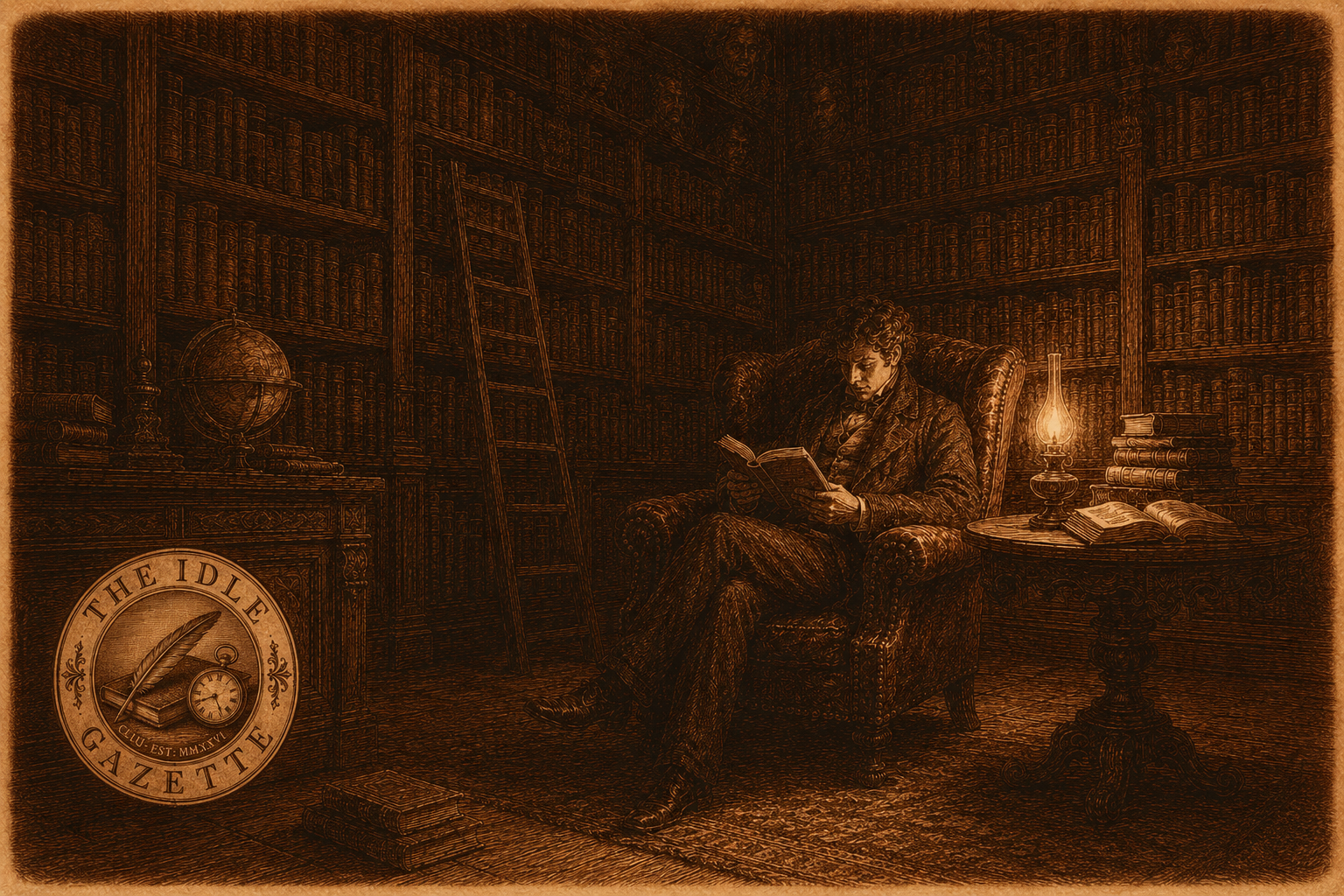
I have spent a great deal of my life among people who are not alive, and I can report that they are, on the whole, better company than the living.
This is not misanthropy. I am fond of the living and number several among my friends. But the living have a flaw that the dead have entirely overcome: they are still happening. They interrupt. They want things. They check their telephones in the middle of your best sentence. They are, every one of them, in the middle of becoming someone slightly different from who they were yesterday, which makes them fascinating and exhausting in roughly equal measure. The dead have finished. They have said everything they are going to say, and arranged it as well as they could before they went, and now they wait on the shelf with a patience no living person can match, for whatever reader happens to be ready.
That readiness is the whole transaction. The dead make no demands on your schedule. Montaigne does not mind that you have not opened him in three years. He is not offended. He does not send a message wondering why you have gone quiet. He sits in his book exactly as he left himself, four and a half centuries ago, and on the evening you finally take him down he resumes the conversation as though no time has passed, because for him none has. This is a kind of friendship the living cannot offer, because the living, mercifully, keep moving.
To read the dead seriously, over years, is to assemble a society of them.
It begins by accident, as all the best societies do. A book is pressed on you, or found on a table, or bought because the blue of the cover looked correct in winter. You read it, and someone speaks to you from inside it who has been gone for a hundred years, or four hundred, or two thousand, and the strange thing, the thing that never stops being strange, is that they are talking about exactly your life. Not life in general. Your specific Tuesday. The dead writer who described, in 1580, the precise quality of his own procrastination, the way his mind wandered when he sat down to work, is describing the morning you have just wasted. He knew. He has been dead since before your country existed and he knew, and he wrote it down so that you, unimaginable to him, would one day recognize yourself in his sentence and feel, for a moment, less alone in time.
This is the thing the dead do that nothing else can. They abolish the loneliness of the present.
The present is a lonely place if it is the only place you live. It insists that its problems are unprecedented, that no one has felt what you feel, that your particular confusion is a new thing in the world requiring new solutions, ideally ones you can purchase. The dead know better. The dead have been confused in all the same ways, and grieved the same griefs, and wasted the same afternoons, and they have left their accounts lying around for anyone willing to look. To read them is to discover that you are not the first occupant of your own life. Others have lived here. They have left notes on the walls.
And here is the thing one notices, after enough years among them, that changes the whole reason for keeping their company: the dead, the ones worth reading, were almost all spectacularly, recklessly, scandalously alive.
This is the great surprise of the library, and it runs exactly opposite to what you would expect of a room full of corpses. The figures who lasted on the shelf are not the cautious ones. They are not the ones who managed their energy, protected their downtime, and died with their reserves intact. They are the ones who burned. They wrote at improper hours, loved the wrong people, walked across continents on foot, drank too much and saw too much and said the unsayable thing at the dinner party that ended the friendship. They got into duels and exile and debt. They produced bodies of work so vast that one wonders when they slept, and the answer, often, is that they did not sleep much, because they were too busy being alive. They seem, reading them, to have lived three or four lives apiece in the span allotted for one, as though they had discovered some private extra hour inside each hour that the rest of us cannot find.
Compare this, honestly, to the people you pass on the street.
I do not say it to be cruel, because I am describing myself on my worst weeks as much as anyone. But look at the faces of the over-managed living: the careful ones, the optimized ones, the ones who track their sleep and ration their effort and protect their bandwidth and arrive everywhere slightly depleted regardless. There is a particular look that the modern busy life produces, and it is not the look of someone burning brightly. It is the look of a flickering light, a flame turned down low to conserve fuel, a person operating permanently at the edge of extinction from an exhaustion that never quite resolves into either rest or intensity. The light in the eyes is always on the brink of going out, not from any single catastrophe but from the slow, total expenditure of a life on things too small to be worth the fuel.
Here is the cruel arithmetic the dead expose. The flickering ones are exhausted, but they are not exhausted from living. They are exhausted from maintenance, from response, from the thousand small obligations that consume the fuel without ever producing the flame. They have spent everything and burned nothing. The candle has guttered all the way down and never once given real light. And the recommended cure, more rest, more recovery, more careful conservation of an energy that is only ever spent on conservation itself, makes the flickering worse, because it accepts the premise that the problem is too little fuel rather than the real problem, which is that the fuel is being spent on nothing worth burning for.
The dead rebels propose the opposite cure, and it is bracing, and it is correct.
They lived with the pedal to the floor. Not frantically, which is a different thing and worse, the frantic person being merely the flickering person moving fast. The dead lived intensely, which is to say they spent their attention and their energy lavishly on the few things that deserved it and refused to spend it at all on the things that did not. They were idle, often spectacularly idle, in the gazette's exact sense, declining the useful and the obligatory with magnificent disregard, precisely so that they could pour everything they had into the walk, the book, the love, the argument, the work that mattered. Their idleness and their incandescence were the same gesture. They refused the small fires so they could become the large one.
This is the lesson the dead teach that no living self-help can, because the living self-help is written by the flickering, for the flickering, to help them flicker more sustainably.
Learn instead from the ones on the shelf. Be a meteorite, not a dying star. The dying star flickers for an age, conserving, dimming, collapsing slowly inward under the weight of its own caution until it goes out without anyone having particularly noticed it was ever lit. The meteorite is brief and total. It spends everything in one incandescent passage across the dark and is seen, and remembered, and it lit the sky for the simple reason that it was not trying to last. The dead in your library are meteorites, every one. They are still burning across the sky centuries later precisely because they refused, while alive, to husband their light.
A person formed by such reading moves through the present as through a slightly foreign country.
This is, I will admit, not always convenient. One becomes a poor citizen of the immediate. The frenzies of the moment, the things everyone is suddenly agreed are urgent, the opinions that arrive in the morning and are compulsory by lunch, these have a thinner texture to a person who has spent the night with someone who watched an empire fall and found it less interesting than his garden. One develops a certain immunity to manufactured urgency. One has seen, through the eyes of the dead, how many urgent things turned out not to matter, and how many things that mattered enormously were not urgent at all and were therefore ignored until it was too late. This makes a person calmer and slightly less useful to those who profit from his agitation. I consider it a fair trade.
The library, then, is not a storehouse. It is a room full of the dead, available for conversation.
I distrust the modern way of speaking about books as content, as information, as things to be consumed and summarized and moved past. You do not consume a friend. You do not summarize a person you love and then discard the original as redundant. The dead in their books are not delivering information to you; they are keeping you company, which is a different and older service. The information in Montaigne could be summarized in an afternoon. The company of Montaigne takes years and is never finished and is the entire point. To read him for information is to invite a wise old friend to dinner and then demand he state his conclusions so you can leave early.
There is a particular grief that comes with this kind of reading, and it is worth naming, because it is part of the gift.
You come to love people you can never meet. You spend a winter with someone, learn the turns of their mind, laugh at jokes they made for an audience now also entirely dead, and then you close the book and remember that they are gone, have been gone for centuries, that the warmth you feel toward them travels in one direction only and can never be returned. They will never know you read them. They will never know that on a grey afternoon in a city they could not have imagined, in a year that would have sounded to them like science fiction, someone took them down from a shelf and felt understood. The friendship is real and it is entirely one-sided, and there is a sweetness in that very impossibility, the sweetness of a gift given by someone who could not have known who would receive it.
This is why the gazette keeps the company it keeps.
Our patron saints are dead, every one of them, or never lived at all, which is its own form of deathlessness. Montaigne has been gone four centuries. Lichter never breathed, which means he cannot stop. We gather them not as nostalgia, not because the past was better (it was mostly worse, and shorter, and full of teeth falling out), but because they have finished becoming themselves and are therefore available in a way the living can never be. They have done their living. Now they are pure company, distilled, waiting on the shelf, asking nothing, offering everything they managed to set down before the end.
The living will tell you this is morbid. Keeping company with the dead, dwelling among old books, preferring the conversation of the deceased to the networking opportunities of the present: surely this is a symptom of something, a failure to engage, a retreat. I have heard the diagnosis. I reject it. There is nothing morbid about the dead. They are the least morbid company imaginable, because they have got the dying over with and emerged into a strange immortality on the page, where they are more alive, frankly, than half the people I see hurrying down the street composing messages they will regret. A man rereading Marcus Aurelius on a park bench is keeping better company than a man at a party where everyone is performing a version of themselves for an audience that is not listening.
So I will make the case plainly, since the gazette is, among other things, a defense.
Keep company with the dead. Read the ones who lasted, not because lasting proves merit (much that lasted is dreadful, and much that was good has vanished) but because the ones who lasted have already been tested against centuries of readers looking for company and finding it. Read them slowly, the way you would talk with an old friend, without the indecent haste of someone trying to extract a summary. Let them describe your own life back to you across the impossible distance. Let them abolish, for an evening, the loneliness of being stuck in a single moment of history with no perspective on it but the moment's own.
And when you close the book, leave it where you can see it, the way you would keep a photograph of someone loved and gone.
The dead are the only company that asks nothing of you and gives everything it has. They will wait. They have nothing but time now, and they are generous with it, and they do not check their telephones, and they will resume the conversation exactly where you left it, on whatever evening you are finally ready to listen.
There is nowhere else, in the whole noisy present, where you will be so well received.
"The dead are the only company that asks nothing of you and gives everything it has. — House Rule.